What is the EPF Interest Rate?
The EPF Interest Rate is the annual return declared by the Employees' Provident Fund Organisation (EPFO) on mandatory retirement savings of salaried Indian professionals. It offers EEE (Exempt-Exempt-Exempt) tax status — making it one of the best risk-free debt instruments in India.
Historical EPF Interest Rate Trend
| Period | EPF Interest Rate | Key Economic Context |
|---|---|---|
| 1990s | 12.0% | High inflation, developing economy |
| Early 2000s | 9.5% | Post-liberalization stabilization |
| 2010s | 8.5% – 8.75% | Growth stabilization |
| 2020–21 | 8.5% | COVID year |
| 2022–23 | 8.15% | Post-COVID rate normalization |
| 2023–24 | 8.25% | Slight uptick |
| Projected 2030+ | 6.5% – 7.0% | India maturing toward developed economy norms |
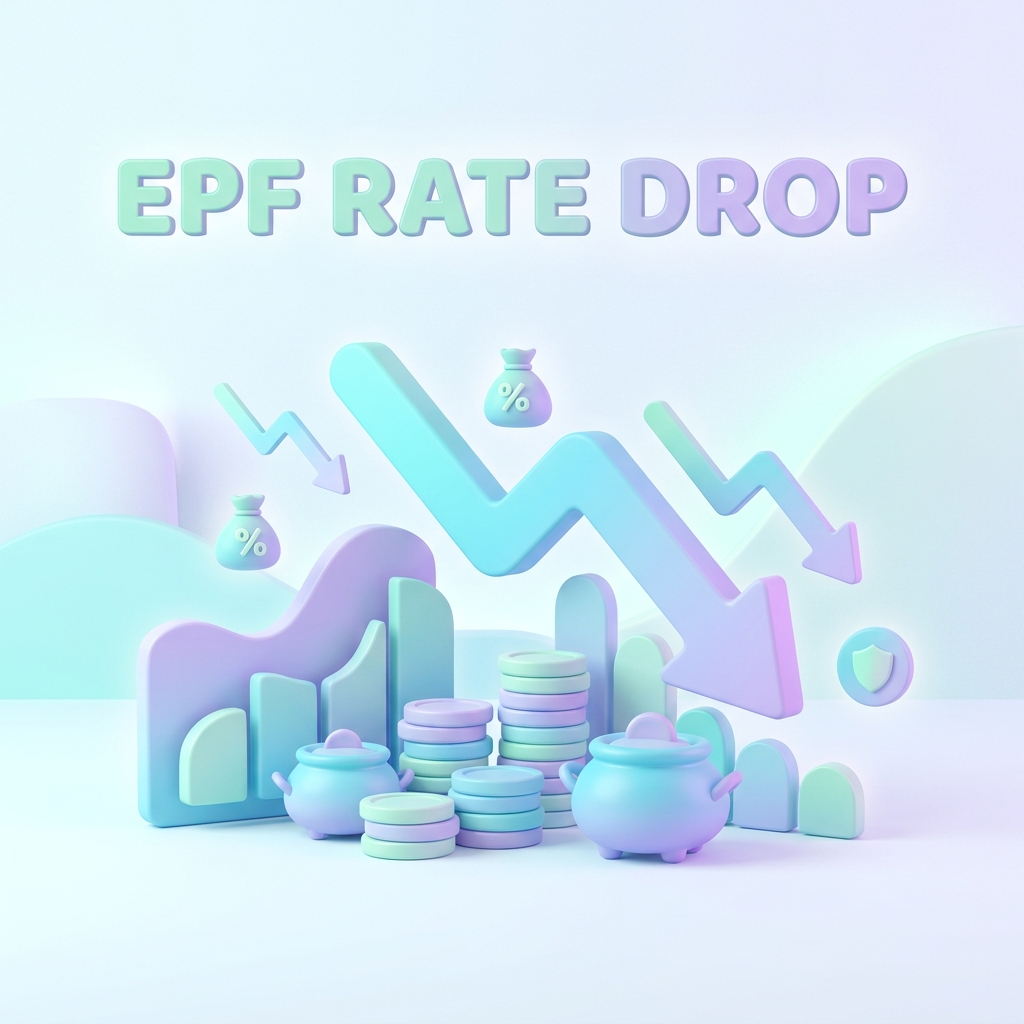
The direction is unmistakably downward over the long term.
Is your FIRE plan stress-tested for lower EPF returns?
Run your retirement simulation with EPF returns modeled at 6.5% instead of 8.25% and see how it affects your FIRE date.
See a Live DemoWhy Will It Drop?
The EPF rate is not arbitrary — it is tightly linked to the 10-Year Indian Government Bond (G-Sec) yield. As India transitions from a developing to a developed economy:
- Structural inflation decreases → RBI lowers repo rate → Bond yields fall
- EPF must follow bond yields → EPFO cannot sustainably pay above-market rates forever
- Comparison with mature economies: Japan and Germany government bonds yield 1-2%. The US 10-Year was 4.5% in 2024 — still far above India's projected trajectory.
Impact on Your FIRE Corpus
| EPF Return Assumption | Corpus at 60 (starting ₹5,000/month EPF at age 25) |
|---|---|
| 8.25% (current) | ₹2.34 Crores |
| 7.0% (conservative) | ₹1.82 Crores |
| 6.5% (pessimistic) | ₹1.65 Crores |
| Difference | ₹69 Lakhs less in the pessimistic scenario |
This is why stress-testing your FIRE plan with conservative EPF assumptions matters.
Should you maximize EPF or invest more in equity mutual funds?
Read our detailed EPF vs Mutual Funds comparison to find the optimal split for your portfolio.
Read the ComparisonWhat Should You Do?
- Do not abandon EPF. It remains the best risk-free, EEE debt instrument available to salaried Indians. Maximize it — especially the Voluntary Provident Fund (VPF) option.
- Model conservatively. When running your FIRE projection, use 7.0% as your EPF return assumption (not 8.25%). This builds in a safety buffer.
- Compensate with equity. Your overall retirement corpus should be 70-80% equity to generate inflation-beating returns. EPF is your debt anchor, not your wealth engine.
FAQs
1. If EPF rates drop, should I switch to PPF for better safety?
Both EPF and PPF have similar risk-free, government-guaranteed characteristics. The key difference: EPF benefits from an employer contribution (free money!). PPF has higher contribution flexibility. The smart strategy is to max out EPF first (including VPF if needed), then use PPF for any additional debt allocation up to ₹1.5 Lakhs/year.
2. Can the government guarantee EPF rates won't drop?
No. EPF rate decisions are made annually by the EPFO Central Board of Trustees, subject to RBI guidelines and the government's fiscal position. There is no statutory minimum rate. Historically, rates have generally trended downward over multi-decade periods.
3. Is there a way to "lock in" the current EPF rate?
No — EPF rates are reset annually and applied to the entire accumulated balance. Unlike a fixed deposit, you cannot lock in today's 8.25% rate for the next 20 years. The rate you earn will change every year based on EPFO declarations. This is another reason to use conservative projections.
4. Should I withdraw my EPF early to invest in equity mutual funds?
This is a complex decision. Early EPF withdrawal before 5 years of service attracts TDS. After 5 years, withdrawal is tax-free. However, moving EPF money into equity funds exposes it to market risk. A better strategy is to leave EPF untouched as your debt anchor and separately increase equity SIP investments. See our EPF withdrawal strategy guide for the detailed math.
5. How does plannF model future EPF rate changes?
In plannF, you can set a custom EPF return rate for your projections rather than using the default current rate. The simulator supports a "step-down" model where you can assume 8.25% for the next 5 years and 7.0% thereafter — accurately reflecting the expected long-term trajectory. This is the recommended approach for any FIRE plan with more than a 15-year horizon.