What is Lifestyle Inflation?
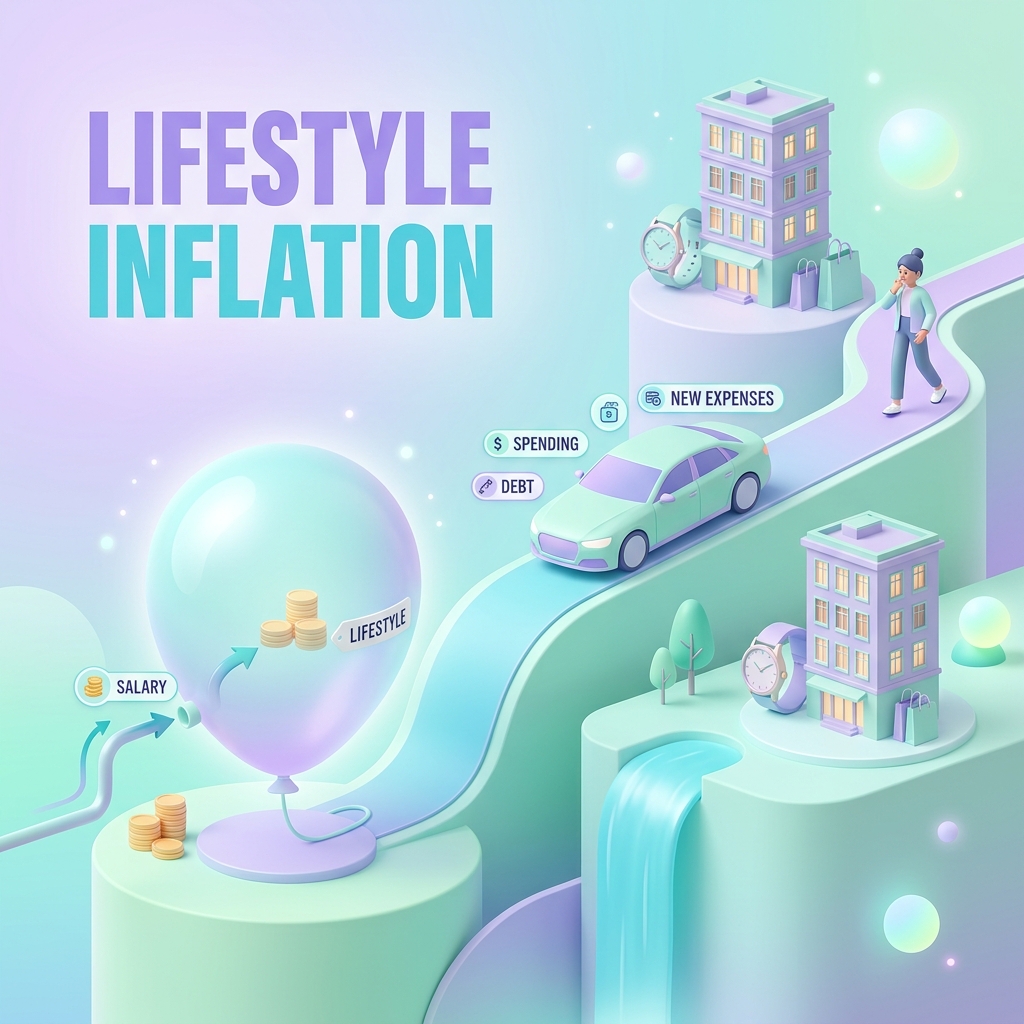
Lifestyle Inflation (or Lifestyle Creep) occurs when your standard of living improves as your discretionary income rises. You get a ₹30,000 raise, so you upgrade your car, buy a premium gym membership, and move to a fancier apartment.
The math is brutal: if your expenses rise in lockstep with your income, your savings rate never improves, and your FIRE date never gets closer — no matter how much you earn.
The Short Answer: The 50/50 Raise Rule
To reach Financial Independence, you do not need to live like a monk forever. You just need to control the rate at which your lifestyle inflates.
The most effective method is the 50/50 Raise Rule. Whenever you receive a salary hike, bonus, or promotion, divide the extra take-home pay exactly in half:
| Portion | Allocation | Action |
|---|---|---|
| 50% | Lifestyle | Enjoy it — new car, dining, travel |
| 50% | Investments | Immediately increase your SIP |
Example: You get a ₹40,000/month raise.
- ₹20,000 → Lifestyle upgrades (yours to enjoy, guilt-free)
- ₹20,000 → Immediately increases your monthly SIP
See how a salary hike today moves your FIRE date.
Model exactly how an extra ₹20,000/month SIP can pull your retirement forward by 3-5 years.
Run a Full SimulationThe "Step-Up SIP" Automation
Do not rely on willpower. Willpower fails.
If your salary hits your bank account on the 1st of the month, your SIPs must automatically deduct on the 2nd. Use a Step-Up SIP mandate (available on platforms like Zerodha, Kuvera, or directly with AMCs) to automatically increase your monthly investment by 10% every single year — perfectly syncing with your annual appraisal cycle.
Step-Up SIP Impact: ₹20,000 Starting SIP at 12% CAGR
| Year | Monthly SIP | Annual Investment | Corpus at Year-End |
|---|---|---|---|
| 1 | ₹20,000 | ₹2,40,000 | ₹2,53,800 |
| 5 | ₹29,282 | ₹3,51,384 | ₹17,66,000 |
| 10 | ₹47,159 | ₹5,65,908 | ₹50,93,000 |
| 15 | ₹75,930 | ₹9,11,160 | ₹1,17,50,000 |
| 20 | ₹1,22,280 | ₹14,67,360 | ₹2,42,00,000 |
Assuming 10% annual step-up in SIP. CAGR: 12%. For illustration only.
By automating this, your savings rate naturally increases over time without ever feeling "deprived."
Calculate the impact of Step-Up SIPs on your retirement date.
See your personalised FIRE projection with salary growth and step-up SIPs already factored in.
Start Your Free PlanFAQs
1. How much lifestyle inflation is "acceptable" for a FIRE aspirant?
A good rule of thumb: your savings rate should improve by at least 2-3 percentage points every year. If you earn ₹1 Lakh/month and save ₹25,000 today (25% rate), by next year after a hike you should save at least ₹28,000-30,000/month. As long as your savings rate grows, moderate lifestyle upgrades are perfectly fine.
2. What if my entire raise goes toward increased EMIs or rent?
This is lifestyle inflation in disguise — and the most dangerous kind. If a raise forces a higher EMI (bigger car loan) or higher rent, your savings rate stays flat. Before taking on any fixed monthly commitment, check that your savings rate will still improve after the new expense.
3. Does the 50/50 rule apply to bonuses too?
Yes, and it is even more powerful with bonuses because they are lump sums. A ₹2 Lakh Diwali bonus — split 50/50 — means ₹1 Lakh goes into a lump sum mutual fund investment and ₹1 Lakh is yours for a vacation or gift. This is far better than spending the entire bonus and feeling guilty, or saving the entire bonus and feeling deprived.
4. Should I use the extra investment toward paying off debt or investing?
If you have high-interest debt (personal loan, credit card above 12% interest), pay that off first. Home loan EMIs at 8-9% are borderline — you could invest instead if your expected equity return is 12%+. See our debt vs. invest calculator for the specific math on your situation.
5. How does plannF help me avoid lifestyle inflation?
plannF lets you model the long-term impact of each lifestyle upgrade decision. Want to upgrade to a ₹20,000/month apartment? Enter the new rent and instantly see how it shifts your FIRE date. This makes lifestyle choices tangible — you can see the exact trade-off between "new apartment" and "retire 1.5 years earlier."