[!NOTE] 2026 Update: All calculations and strategies in this guide have been updated to reflect the removal of indexation benefits and the new 12.5% LTCG tax slab introduced in the latest budget.
The Dream vs. The Reality
You've heard the stories. A 35-year-old IT professional quits their job, moves to Goa, and lives off their investments forever. It sounds like a dream. But the reality of achieving FIRE (Financial Independence, Retire Early) in India is far more complex than reading a few blogs from the US and blindly buying mutual funds.
If you apply Western FIRE rules to an Indian economic reality, you will run out of money.
This guide is the definitive, mathematically sound blueprint for achieving true Financial Independence in India.
What is FIRE?
Financial Independence, Retire Early (FIRE) is a financial movement defined by extreme savings and aggressive investing, allowing individuals to accumulate a corpus large enough to sustain their lifestyle indefinitely without needing active employment income.
Find out exactly when you can FIRE.
Don't use generic multipliers. Input your current savings rate and expenses into plannF to see your exact timeline to complete Financial Independence.
See a Live DemoThe Core Math Behind FIRE
At its core, FIRE is entirely dictated by your Savings Rate and your Safe Withdrawal Rate (SWR).
The 25x Rule (And Why It Is Dangerous in India)
The standard global rule of thumb for FIRE is that you need 25 times your annual expenses to retire. This is based on the famous Trinity Study, which found that withdrawing 4% of your portfolio annually was safe in the US.
Target FIRE Corpus = Annual Expenses × 25
Example: If you spend ₹1 Lakh a month (₹12 Lakhs a year), the 25x rule says you need a corpus of ₹3 Crores (12L x 25) to retire.
The Indian Problem: The 4% rule assumes US inflation (around 2% to 3%). In India, true lifestyle inflation is closer to 7%, and healthcare inflation routinely hits 14%. Because of this, most serious Indian FIRE practitioners use a much more conservative multiplier, usually aiming for 30x to 35x annual expenses.
The Indian SWR Table
| Withdrawal Rate | Multiplier Needed | Scenario Appropriateness | Risk of Portfolio Failure (India) |
|---|---|---|---|
| 4.0% | 25x Annual Expenses | Traditional 60+ Retirement | Very High (for early retirees) |
| 3.5% | 28x Annual Expenses | Coast FIRE / Lean FIRE | Moderate |
| 3.0% | 33x Annual Expenses | Standard FIRE (Age 40-45) | Low |
| 2.5% | 40x Annual Expenses | Fat FIRE (Luxurious Lifestyle) | Almost Zero |
The Three Flavors of FIRE
Not everyone wants to quit working completely. In India, three distinct paths have emerged:
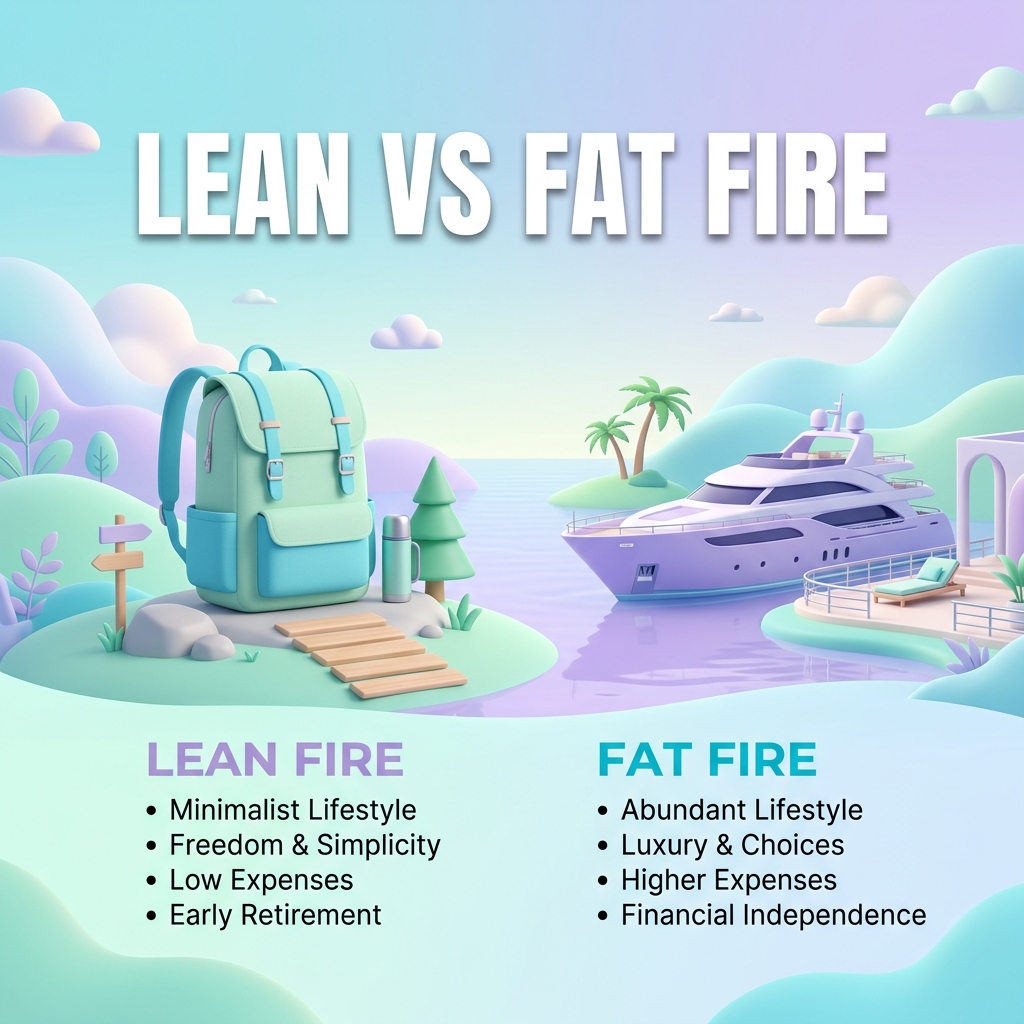
- Lean FIRE: Retiring with a highly optimized, minimalist lifestyle. (Corpus: ~₹1.5 to ₹2.5 Crores). Highly dependent on Tier-2/Tier-3 city living.
- Fat FIRE: Retiring with enough wealth to fund a luxurious lifestyle, including international vacations and premium healthcare. (Corpus: ~₹8 to ₹15+ Crores).
- Coast FIRE / Barista FIRE: Building a corpus large enough that it will compound to your final retirement number by age 60 without any further contributions. You then downshift to a lower-stress, lower-paying job that just covers your current daily expenses.
The Indian Portfolio Constraints
To achieve any of these FIRE flavors, your portfolio must be structurally sound against Indian constraints.
1. The Inflation Trap
You cannot use a flat inflation rate. If your basic expenses inflate at 6%, but education and medical care inflate at 12%, a simple spreadsheet will fail you. You must segregate your corpus into distinct "buckets" (e.g., a dedicated Health Corpus that grows in aggressive equity to outpace 14% inflation).
2. The Tax Drag
When projecting your corpus, you must account for the 12.5% Long-Term Capital Gains (LTCG) Tax on equity. A ₹5 Crore portfolio is actually only worth ₹4.5 Crores after you factor in the tax you'll pay when liquidating it via SWP.
3. The Real Estate Illusion
Many Indians have a net worth of ₹5 Crores, but ₹4 Crores of it is locked in their primary residence. You cannot buy groceries with bricks. Your primary home is not an investable, yield-generating asset. Exclude your primary residence from your FIRE corpus calculations.
Simulate variable inflation and Indian taxes.
Stop relying on simple math. Run your retirement through plannF to automatically apply the 12.5% LTCG tax and dynamic inflation rates to your 40-year withdrawal sequence.
Start Your Free PlanFAQs
1. Can I retire with 2 crores in India?
Yes, but only if you practice extreme Lean FIRE in a low-cost Tier-3 city, own your home outright, have zero debt, and maintain a withdrawal rate strictly under 3% (spending less than ₹50,000 to ₹60,000 a month).
2. What salary do I need to become financially independent?
FIRE is not about your absolute salary; it is about your Savings Rate. A person earning ₹1 Lakh a month who saves 60% of it will achieve FIRE much faster than a person earning ₹3 Lakhs a month who saves only 10% because the high earner has massive lifestyle expenses to cover.
3. Should I clear my home loan before achieving FIRE?
Yes, absolutely. Entering early retirement with a massive, fixed EMI is mathematically dangerous. Clearing debt lowers your monthly expense burden, reduces your required target corpus, and protects you from forced equity sales during market crashes.
4. How do I protect my FIRE corpus from a stock market crash?
You build a "Bond Tent" or use a "Bucket Strategy". You keep 3 to 5 years' worth of living expenses in highly safe, liquid debt instruments (like Arbitrage funds or FDs). If the stock market crashes, you pause equity withdrawals and live off the debt bucket until the market recovers.
5. How does plannF model the complexity of Indian FIRE?
plannF calculates the exact LTCG tax drag, allows you to split inflation by category, excludes your primary home from liquid cash flow calculations, and stress-tests your entire strategy using Monte Carlo simulations of the Indian market.