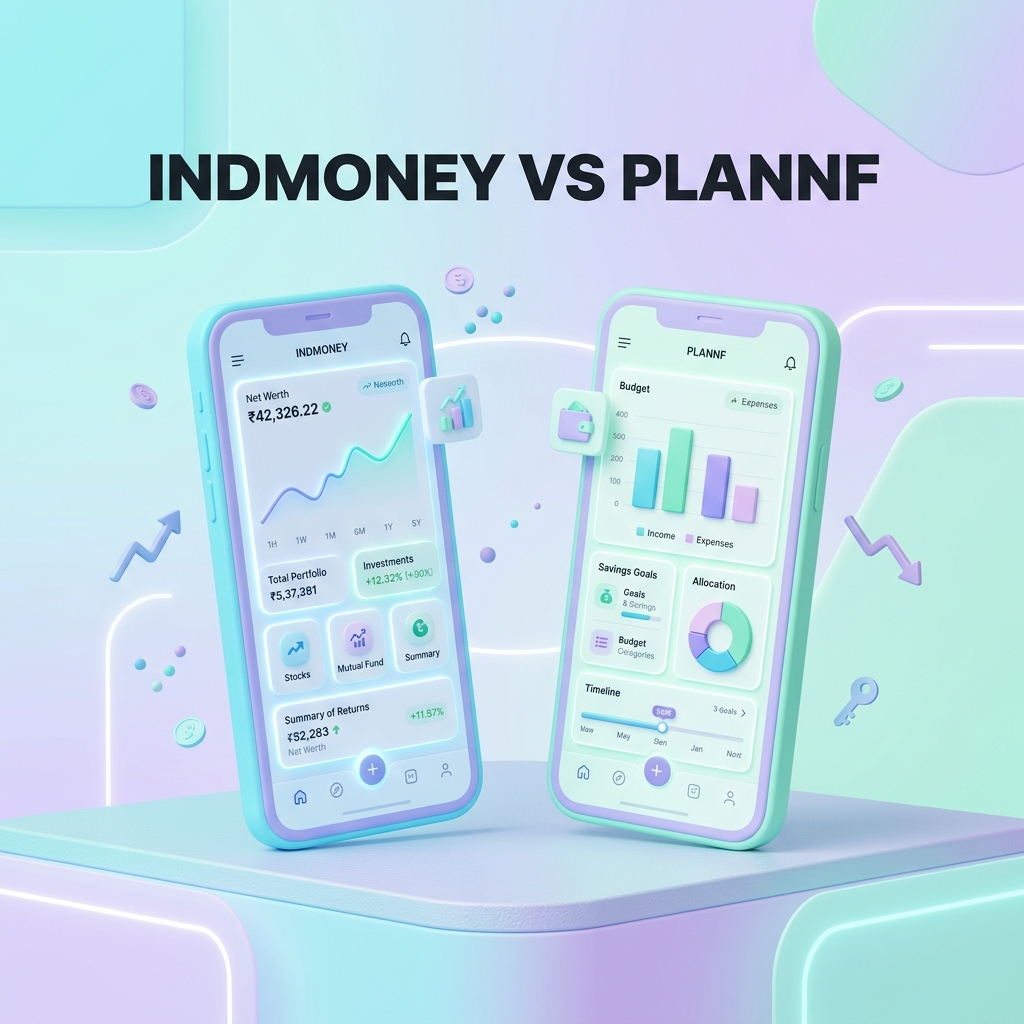
The Rearview Mirror vs. The Windshield
If you are a financially savvy Indian, there is a very high chance you have INDmoney installed on your phone.
It is arguably the best "Account Aggregator" on the market. You give it access to your Gmail, and within minutes, it pulls your Consolidated Account Statement (CAS), tracks your EPF, syncs your stocks, and gives you a beautiful dashboard showing exactly how much you are worth today.
It is a fantastic rearview mirror. For forward-looking retirement planning, you need a simulator, not just a tracker. See also plannF vs IndMoney and Kuvera. It tells you exactly where you are and how you got there.
But if your goal is Financial Independence and Early Retirement (FIRE), you don't just need a rearview mirror. You need a windshield. You need to know if the ₹1 Crore you see on your INDmoney dashboard today is actually enough to fund a 40-year retirement starting a decade from now.
And that is where INDmoney hits a wall, and where plannF takes over.
Feature Breakdown: Aggregator vs. Simulator
| Feature | INDmoney | plannF FIRE Simulator |
|---|---|---|
| Core Function | Tracks current portfolio value | Simulates future portfolio survival |
| Data Connection | Reads Email/SMS for auto-sync | Manual input (100% Privacy) |
| Inflation Logic | Flat or non-existent | Variable by expense category |
| Withdrawal Taxes | None (Gross tracking) | Simulates LTCG & Tax Regimes dynamically |
| Scenario Testing | No | Yes (Alternate timeline modeling) |
| EPF/PPF Logic | Shown as current liquid balance | Locked until maturity/age 58 |
| Business Model | Cross-selling loans/US stocks | Subscription for advanced math engine |
Project your wealth, don't just track it.
Take the top-line numbers from your INDmoney dashboard and plug them into plannF to see exactly what year you can safely retire.
See a Live DemoWhy Asset Aggregation Isn't Financial Planning
INDmoney's core business model revolves around tracking current assets and facilitating transactions. It is not designed to be a multi-decade financial simulator. Here is where the gap becomes dangerously apparent for FIRE planners:
1. The Variable Inflation Problem
If you try to map a retirement goal in a basic tracking app, it will use a flat inflation rate (say, 6%). But anyone planning to retire in India knows that while lifestyle might inflate at 6%, healthcare costs inflate at 12% to 14%. INDmoney doesn't allow you to decouple your expense categories and apply distinct compounding rates over 40 years. plannF does.
2. The Taxation Black Hole
INDmoney is great at telling you how to save tax today (by suggesting ELSS funds). But what about when you stop working?
In retirement, you must manage Long-Term Capital Gains (LTCG) tax on mutual fund withdrawals, and optimize between the Old and New Tax Regimes to minimize your outflow. Aggregators cannot simulate a 30-year withdrawal phase that accounts for shifting tax brackets. plannF's built-in Indian tax engine handles this automatically.
3. The "What-If" Scenario
Life is messy. What if the market crashes by 30% the year after you retire? What if you buy a vacation home at age 50? INDmoney is a static snapshot. It cannot run side-by-side Monte Carlo simulations or alternate timeline comparisons.
The Ultimate Differentiator: Your Privacy
To make INDmoney work seamlessly, you must grant it permission to read your personal emails or parse your SMS inbox. The app is free because you are the product. They analyze your financial habits to cross-sell you loans and credit cards.
plannF is a 100% Client-Side application. When you build your financial plan in plannF, all your data (your net worth, your goals, your EPF balances) is stored locally in your own browser. It never touches our servers. We do not read your emails, we do not sell your data, and we have zero financial products to push on you.
Use Both, But Know The Difference
You don't have to choose one or the other. Use INDmoney to track your monthly SIPs and check your current stock portfolio.
But when you sit down on a Sunday morning to answer the most important question of your life—"Am I financially free?"—you need a simulator.
Protect your privacy and project your future.
Build your complete 40-year FIRE plan in complete anonymity with plannF's client-side architecture.
Start Your Free PlanFAQs
1. Does plannF connect to my INDmoney account?
No. plannF is a privacy-first platform that does not use account aggregators or email scraping. You simply look at your consolidated balance on INDmoney and manually input the top-line numbers (Equity, Debt, EPF) into plannF. It takes 2 minutes and ensures total privacy.
2. Can I use INDmoney's goal calculators for FIRE?
INDmoney's goal calculators are great for simple, linear goals (like saving for a car in 3 years). However, they lack the sophisticated tax engines, variable inflation modeling, and Sequence of Returns Risk testing required for a complex 40-year early retirement plan.
3. How does plannF handle EPF differently from INDmoney?
INDmoney shows your EPF as part of your current liquid net worth. For FIRE planning, this is dangerous because you cannot withdraw EPF until age 58. plannF correctly models EPF as a time-locked asset, compounding it separately and preventing your retirement simulation from spending it before you are legally allowed to.
4. Why is a client-side architecture important for financial planning?
FIRE planning requires inputting your most sensitive life data: exact net worth, future inheritances, spouse income, and spending habits. Client-side architecture means this data stays on your physical device and never hits our servers, eliminating the risk of data breaches or targeted advertising.
5. Do I have to pay for plannF?
plannF operates on a freemium model. You can build a basic plan for free. Advanced features like Monte Carlo simulations, complex Indian tax regime optimization, and side-by-side scenario comparisons are part of a premium subscription — because we sell software, not your data.