The Battle of the Giants
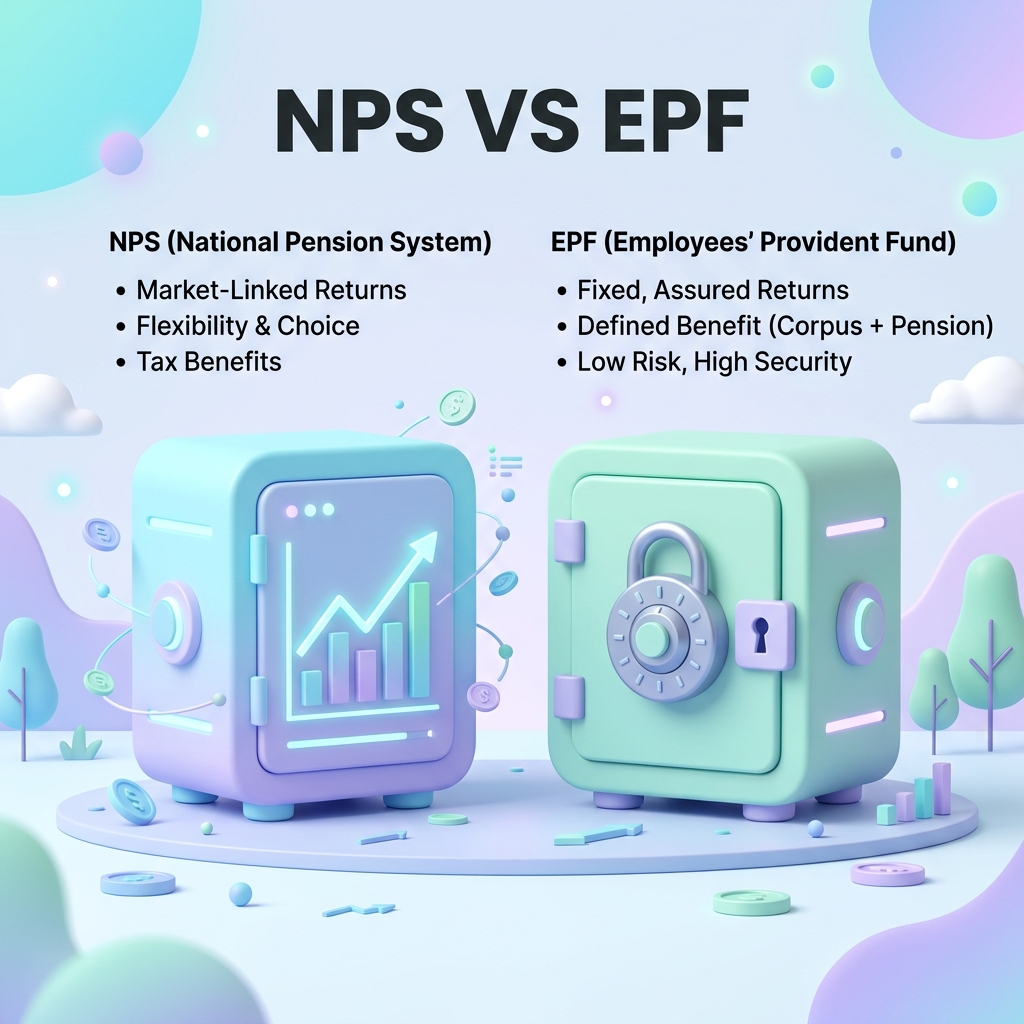
Every Indian salaried professional has two government-backed retirement pillars: EPF and NPS. Both lock your money away until near age 60. Both offer tax deductions. But they are structurally very different — and choosing where to put your extra voluntary savings matters enormously for FIRE.
Side-by-Side Comparison
| Feature | EPF + VPF | NPS |
|---|---|---|
| Return Type | Fixed (8.25% currently) | Market-linked (7-15% based on equity %) |
| Tax on Contribution | Section 80C (up to ₹1.5L) | 80C + extra ₹50K via 80CCD(1B) + 80CCD(2) |
| Tax on Interest | EEE (tax-free) | Grows tax-deferred |
| Withdrawal at Retirement | 100% lump sum, 100% tax-free | 60% tax-free, 40% must buy annuity |
| Annuity requirement | None | Mandatory 40% at 60 |
| Annuity income tax | N/A | Fully taxable at slab rate |
| FIRE flexibility | High — withdraw at 58 (or after 60 days unemployment) | Low — locked until 60 |
| Equity exposure | None | Up to 75% |
Model your EPF vs. NPS allocation in your FIRE plan.
plannF handles both EPF and NPS as future-dated assets with different unlock rules, tax treatments, and payout structures in your unified retirement projection.
See a Live DemoThe Corpus Comparison: 30-Year Accumulation
| ₹10,000/month invested for 30 years | EPF (8.25% guaranteed) | NPS (50% equity: ~10.5% CAGR) | NPS (75% equity: ~12% CAGR) |
|---|---|---|---|
| Corpus at 60 | ₹1.47 Crores | ₹2.10 Crores | ₹2.63 Crores |
| Tax-free withdrawal | ₹1.47 Crores (100%) | ₹1.26 Crores (60%) | ₹1.58 Crores (60%) |
| Forced annuity | None | ₹84 Lakhs @ 6% = ₹4,200/month | ₹1.05 Crores @ 6% = ₹5,250/month |
| Annuity income tax | N/A | Taxable at slab | Taxable at slab |
| Effective tax-free corpus | ₹1.47 Crores | ₹1.26 Crores | ₹1.58 Crores |
NPS (75% equity) wins on corpus, but EPF wins on flexibility and tax-free withdrawal.
The Tax Advantage Analysis
NPS Extra Tax Deduction (The Main Case for NPS)
| Tax Saving | Details |
|---|---|
| Section 80CCD(1B) | Extra ₹50,000 deduction beyond 80C — saves ₹15,000 (30% bracket) or ₹10,000 (20% bracket) per year |
| Section 80CCD(2) — Corporate NPS | Employer contributes up to 10% of basic — fully tax-free, no limit |
| Result | Corporate NPS is the most tax-efficient savings mechanism in India |
The optimal strategy: Use Corporate NPS (employer contribution) aggressively for the extra deduction. This money is "free" in the sense that it's your employer's contribution, untouched by 80C limits.
The FIRE-Specific Verdict
| Situation | Recommendation |
|---|---|
| Early retirement target (45-50) | Maximize EPF/VPF first — better FIRE flexibility |
| Corporate NPS available from employer | Always take it — free tax saving on employer's contribution |
| Standard NPS Tier 1 (self) | Invest ₹50,000/year for 80CCD(1B) deduction, treat rest as EPF priority |
| Late retirement (58-60) | NPS equity becomes more attractive for final corpus size |
| No FIRE goal, 30+ year horizon | NPS (75% equity) may provide larger total corpus |
The Annuity Problem
NPS's mandatory 40% annuity is its biggest flaw for FIRE practitioners:
| Annuity Issue | Impact |
|---|---|
| Fixed, non-inflation-adjusted payout | Loses real value over 20-30 years |
| Taxable at slab rate | Effective yield drops to 4-4.5% after 30% tax |
| Poor annuity rates (~6%) | Worse than EPF's 8.25% EEE return |
| No lump-sum flexibility | Cannot reinvest in equity for higher returns |
This is why we recommend treating NPS as a supplementary vehicle, not the primary FIRE corpus.
See how EPF, NPS, and mutual funds combine in your FIRE timeline.
plannF models EPF unlocking at 58, NPS lump sum at 60, and NPS annuity income with correct slab-rate taxation — all integrated with your equity SWP withdrawal plan.
Start Your Free PlanFAQs
1. Should I choose EPF/VPF or NPS for my additional voluntary retirement savings?
For early retirees targeting FIRE at 45-50: EPF/VPF first, because the entire corpus can be withdrawn tax-free after 58 (or after 60 days of unemployment). NPS's mandatory 40% annuity and the forced lock-in to 60 reduces its flexibility significantly for early retirees. For those targeting standard retirement at 58-60 with Corporate NPS available, NPS (75% equity) may generate a larger total corpus.
2. What is Corporate NPS and why is it different from individual NPS?
Corporate NPS is when your employer contributes to your NPS account under Section 80CCD(2). This employer contribution is tax-free with no limit (up to 10% of basic salary) — meaning a ₹1 Lakh basic salary employee gets a tax-free ₹10,000/month NPS contribution from the employer. This is the most tax-efficient employer benefit in India and should be taken if offered. It does not reduce your 80C or personal NPS 80CCD(1B) limits.
3. Can I withdraw from NPS before 60 in case of an emergency?
Partial withdrawals are allowed from NPS after 3 years for specific reasons only: higher education, marriage, construction/purchase of a first house, treatment of critical illness, or disability. The withdrawn amount (up to 25% of your own contribution) is tax-free. For general FIRE income, you cannot access NPS before 60 without penalties — which is why NPS should not be your primary FIRE corpus.
4. What happens to my NPS if I die before 60?
Your nominee receives the full NPS corpus as a tax-free lump sum — no mandatory annuity applies in the case of death. This makes NPS an excellent supplementary instrument from an estate planning perspective. If death occurs after 60, the 60%/40% rule applies to the corpus remaining, and the nominee can receive the 60% tax-free and use the 40% for an annuity.
5. How does plannF model the NPS annuity in retirement income projections?
In plannF, you enter your current NPS balance and monthly contribution. At your specified retirement age (minimum 60), it calculates the 40% mandatory annuity amount and models the annuity as a fixed monthly income stream with the applicable slab-rate tax. The 60% lump sum is added to your investable corpus. You can model this alongside your EPF and equity SWP to see the combined monthly retirement income.