The Great Indian Financial Mistake
If you ask the average Indian in their 50s how they saved for retirement, they will likely pull out a stack of LIC Endowment policies or ULIPs (Unit Linked Insurance Plans).
For decades, we were sold the idea that insurance and investment should be combined. "Why pay for term insurance if you get nothing back when you survive?" the agents ask. "Buy this endowment plan! You get life cover AND a guaranteed ₹50 Lakhs at maturity!"
If you are pursuing Financial Independence and Retire Early (FIRE), falling for this pitch is the single biggest mathematical mistake you can make. It will delay your retirement by a decade.
Here is exactly why you must Buy Term and Invest the Rest.
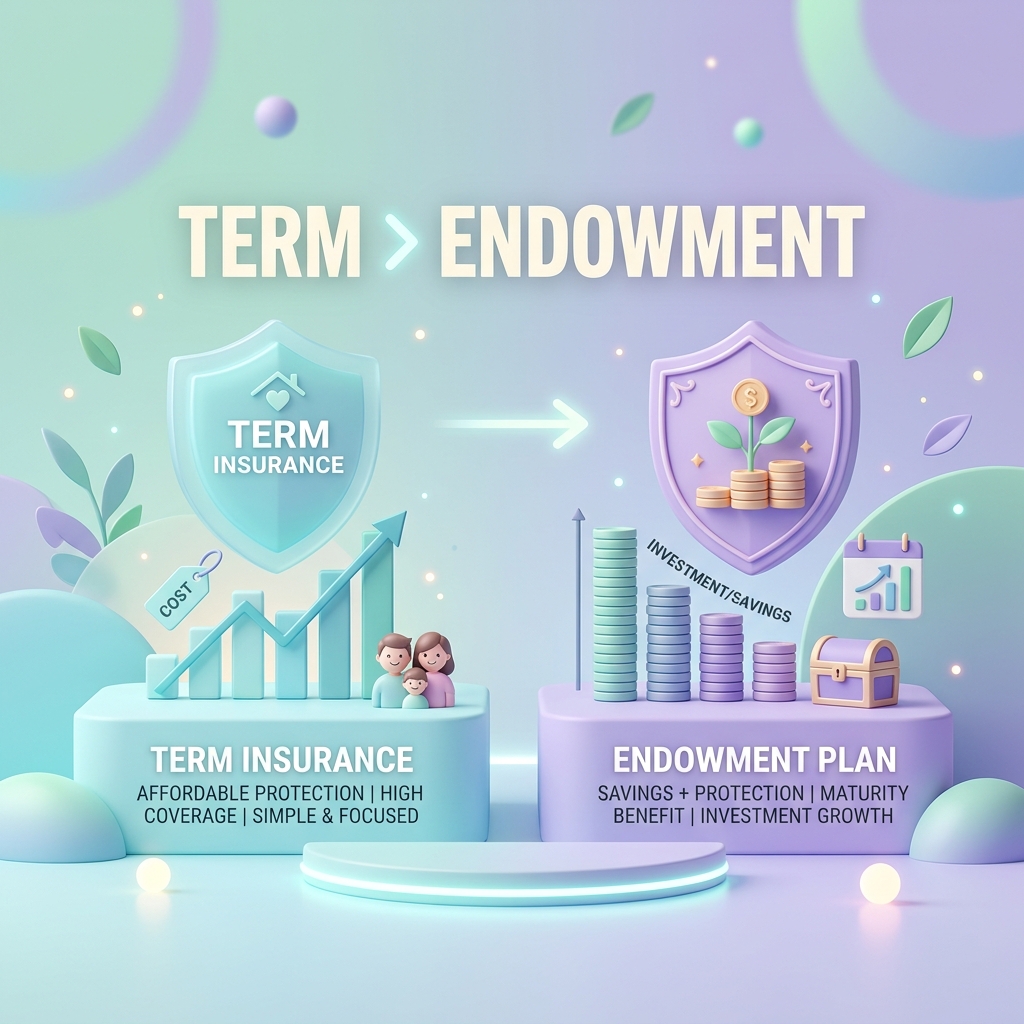
What is Term Insurance?
Term Insurance is a pure life cover. You pay a small premium every year. If you die during the term, your family gets a massive payout (e.g., ₹1 Crore). If you survive the term, you get absolutely nothing back.
What is an Endowment Plan (or ULIP)?
An Endowment Plan mixes insurance with investment. You pay a massive premium every year. A tiny portion goes towards your life cover, and the rest is invested by the insurance company to pay you a "maturity benefit" when the policy ends.
Don't let toxic policies ruin your projection.
Input your current endowment plan premiums into plannF and compare them against a pure index fund approach to see exactly how much wealth you are losing.
See a Live DemoThe Mathematical Breakdown
Let's look at a 30-year-old trying to secure a ₹1 Crore life cover for the next 30 years.
Scenario A: The Endowment Route (The Mistake)
To get a ₹1 Crore life cover through an endowment or money-back policy, the annual premium is astronomical.
- Annual Premium: Roughly ₹1,00,000 per year.
- The Promise: If you survive for 30 years, you get your money back plus a bonus (roughly ₹65 Lakhs at maturity).
- The Internal Rate of Return (IRR): If you run the cash flows through an IRR calculator, endowment plans historically return between 5% and 6%.
- The Problem: 5.5% does not even beat Indian inflation (6.5%). By locking ₹1 Lakh a year into this policy, you are mathematically destroying your purchasing power.
Scenario B: Buy Term & Invest the Rest (The FIRE Way)
You decouple your insurance from your investments.
- The Insurance (Term Plan): You buy a pure ₹1 Crore Term Plan. The annual premium is just ₹10,000.
- The Investment (Equity Funds): You take the remaining ₹90,000 that you would have paid to the endowment plan, and you invest it in a Nifty 50 Index Fund (assuming 12% return).
The Final Comparison Table
| Metric | Endowment Plan | Buy Term + Invest (Nifty 50) |
|---|---|---|
| Annual Cash Outflow | ₹1,00,000 | ₹1,00,000 (₹10K Term + ₹90K SIP) |
| Life Cover (If you die) | ₹1 Crore | ₹1 Crore |
| Internal Rate of Return (IRR) | ~5.5% | ~12.0% |
| Maturity Value (If you survive) | ₹65 Lakhs | ₹2.4 Crores |
What happens after 30 years in Scenario B? You survived, so the Term Plan pays you nothing. You "lost" ₹3 Lakhs in premiums. However, your ₹90,000 annual investment in equity has compounded to ₹2.4 Crores.
By separating insurance from investment, you generated nearly 4x the wealth for the exact same annual cost.
The Agent's Commission
Why do bank relationship managers push Endowment plans so aggressively? Because the first-year commission on an Endowment plan or ULIP can be up to 35% of your premium. If you pay ₹1 Lakh, the agent pockets ₹35,000. If they sell you a pure Term plan for ₹10,000, they make almost nothing.
Separate Church and State
In the FIRE movement, Insurance is for protection against catastrophic loss. Mutual Funds are for wealth creation. Never mix the two.
Optimize your asset allocation.
Model the true compounding power of pure Equity Mutual Funds in plannF and see how quickly you can hit FIRE without the drag of low-yield insurance.
Start Your Free PlanFAQs
1. I already have an Endowment plan, should I surrender it?
It depends on how long you have held it. If you just bought it 1 or 2 years ago, it is usually mathematically better to take the surrender loss, buy a term plan, and redirect the heavy premiums into equity. If it matures in 3 years, it may be better to just hold it to maturity. You must calculate the IRR of the remaining cash flows.
2. Aren't ULIPs better than Endowment plans because they invest in equity?
ULIPs are slightly better than traditional endowments because they invest in equity, but they are still inferior to direct mutual funds. ULIPs have heavy front-loaded charges (premium allocation charge, mortality charge, policy administration charge) that severely drag down your returns in the first 5 years.
3. What if I outlive the term insurance and get nothing back?
That is the best possible outcome! It means you didn't die prematurely. You should view term insurance premiums exactly like car insurance premiums. You pay car insurance hoping you never have to use it. You don't ask for a refund if you don't crash your car.
4. Do I need term insurance after I achieve FIRE?
No. Once you hit your FIRE corpus (e.g., ₹5 Crores), you are self-insured. If you pass away, your family inherits the ₹5 Crores, which is more than enough to sustain them. You can usually safely drop your term insurance once you are financially independent.
5. How does plannF handle term insurance premiums?
plannF treats term insurance correctly: as an expense. You add the premium as a fixed annual cash outflow in your budget. The system ensures it is paid until your specified coverage end date, allowing you to accurately project the massive growth of your remaining liquid investments.